Hey all, thanks for the support in light of the ODC closure.
I wanted to update you on three things regarding the future of the site and our writers:
1 — I will most likely continue to write for a few different websites. The running of the site is the worst part by far, and I think I could handle writing still, for sure. I’ll keep you updated.
2 — I am also looking at finding some of our more prominent writers positions on other sites to make up for shutting the site down.
3 — There is an offer on the table for someone else to take over The ODC, including (gasp) possible financial compensation for me for my troubles. If this were to go through, I would stay on as a writer and, I think, the site would remain fairly similar to it is now.
There is also a slight chance that I don’t close the site, but contract it and change the admin structure to take away the pressure/stress of actually running things. This seems unlikely at this point but is still a possibility.
“I’ma have to shut the studio down…” – P-Diddy
“It is ALL over!” – Mike Goldberg
“Game Over” – Lil’ Flip
I’m trying to make this thing as clichéd as possible. Unfortunately, this is not one of those funky new Rumor Mill things I’ve been doing.
The On Deck Circle is actually shutting down. With some degree of regret, I have battled with the decision for a few weeks now and decided it’s best if I just stop doing the site. While I have obviously not lost my passion for sports, I have lost my interest in writing about it with great frequency and maintaining the website. It takes more work than you’d think to edit and manage a staff of roughly 30 writers, all while trying to write your own work for a few different websites. It’s taxing, both in terms of time and mental state. Additionally, the site has made me less of a sports fan – not only is there less time available, but I sometimes dread reading/writing/watching sports because it has gotten to feel borderline like work. I know this sounds kinda cliché, but the one thing I’ve learned running the site the last 6 months is that I might not want a profession in sports like I thought…it may be best left as a passionate hobby. This is still unclear, but running the site and writing has most definitely hurt my enjoyment of sports.
I grew the site from nothing to a 1200+ hits per day site with 30 writers and nearly 100,000 hits in July. It’s pretty impressive and will hopefully make good interview fodder. Just thought I’d pat myself on the back there.
I need to seriously thank all 30-ish people who have wrote for the site from time to time. The amount and variety of writers is what made the site pretty unique, and I appreciate all the hard work you guys put into it. I love working with my friends in this type of capacity and appreciate your work.
This goes times infinity for Stu Wilkinson (who deserves his own Gary Roberts Wednesday he’s so underappreciated), Alex Jackson (the Hit Counter MVP) and Trevor Smith (the Post Quality MVP). These guys have shouldered the writing load mightily and made the whole experience much more enjoyable for me.
A special thanks to Tas and Skeets from The Basketball Jones, Ryne from Odenized/Slam, Ryan and Austin from Hoops Addict, Dennis from About.com/Gear Live Media, Matt from Hardwood Paroxysm, and many more for their contributions to my evolution as a writer and site operator.
And a major thank you to anyone who ever read the site, provided feedback, told a friend, whatever…if you’re here or have been, thank you!
Before I sign off, I thought I’d pay homage to the articles with the most traffic in site history. Tip of the cap to these.
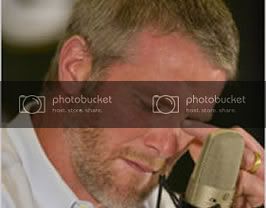
And finally…I felt the most appropriate way to end the site’s tenure was with a Video of the Day. I thought about Brett Favre’s retirement speech, or the Lou Gehrig speech, or the Jimmy V speech, or any number of other emotional retirement speeches. Instead, I found and settled on the greatest retirement speech of all time, and a fitting one at that.
The alarm sounds, and the clock blinks 7:00am. Bruce Buffer hops out of bed, throws on his grey silk robe, and heads downstairs. After flicking on the coffee maker, he yawns and grabs a bottle of water. His wife, Annie Buffer, arrives soon after, dressed in a matching robe.
Bruce Buffer: Good morning! And WELCOME to Wednesday, August 13, LIVE from the Buffer Household on Deerwood Avenue!
Annie Buffer: *Sigh…*
—
It is 7:30, and Bruce heads up to his son’s room.
Bruce Buffer: It’s TIME! To wake up for school! Today’s school day is scheduled for six classes at Peabody Elementary! More after the jump!
Last week, I posted a link to Hoops Addict’s Floor Burn Tournament, a tournament appreciating under-heralded players from around the league. Trev Smith and I both participated, and while my selection of Damien Wilkins for Oklahoma City has not moved on to round two, I thought I should post a link anyways. Ya…Damien Wilkins…OKC…what were my chances?
Okay, so the picture probably isn’t a fitting one, since Manny Ramirez more closely parallels The Joker than Batman, but the image is important. It is Manny Ramirez…in a Los Angeles Dodgers uniform. The trade that sent him there has upset some, and it has opened the discussion about whether or not there is a place in baseball for a playercharacter like Man-Ram. “Manny being Manny” annoyances aside, he is widely criticized for his poor demeanor, lack of seriousness, and apparent idiocy on and off the field. Dreadlocks, a dirty helmet, misplayed fly balls, and the occasional high five to a fan all summate to make the population wonder whether Manny even cares, and whether he’s even worth our time.
Well, you may remember a little feature I wrote about another Red Sock, J.D. Drew. It was called “Don’t Hate the Player…” and was to be the first in a series where I “shine a little light on a good player that maybe wouldn’t otherwise get that light.” Obviously, Manny has plenty of light shone his way, so the axiom of the feature has been changed to appreciating the sometimes-disliked. That’s almost as broad a definition as the mission of Gary Roberts Wednesdays, so kudos to me. Regardless, Manny Ramirez is one of the best baseball players of all time. It’s a fact…don’t hate the player, hate the game. More after the jump!
Ryan from Hoops Addict hatched an idea that fits in really well with what we do here at The ODC - appreciating the otherwise underappreciated. With that in mind, Ryan created the Hoops Addict Floor Burn Tournament, where bloggers representing every team in the NBA (via team-specific blogs, usually) nominate a ‘hustle/energy/Gary Roberts Wednesday’ player to participate in a tournament to crown the Floor Burn Champion. Obviously, I took part (representing Oklahoma City…for whatever reason). Trev Smith also participated (representing Golden State instead of his beloved Lakers, though he got a Lakers plug in nonetheless).
Anyways, check it out and vote for your favorite in each match up by August 11, when the next round will begin.
I took an in depth look at Kevin Pritchard’s rise through the Portland Trail Blazers organization and the moves that he has made to create a disgusting team for the next few years. The core is awesome, everyone is young, and everyone has high character features. Pritchard is the man.
I’m just going to go ahead and say it – contrary to popular opinion and widespread rumors, the Toronto Blue Jays are not going to trade A.J. Burnett before the July 31 trade deadline. At least, they shouldn’t.
Granted, the Jays have next to no chance of making the playoffs this year, so you could easily make the case that it’s time to begin selling off any pieces of short-term value for long-term help. In fact, it’s so easy to set out the argument that I will, for you.
The argument goes like this – the Jays aren’t making the playoffs, and Burnett can opt out of his contract at the end of the year, so the Jays should get something for him while they can. This goes for other players who won’t help in the long run, too (though the team has little of value to deal). The logic is that if you can’t win now, you should do everything you can to make winning easier in the future. Additionally, Burnett is making close to $12M this year, and you would therefore be off the hook for about $4M of that if you dealt him this month. That money, they say, could be rolled over to next year’s payroll.
That’s all fine and dandy, but there are four major hang ups with that logic. More after the jump!
Hey, remember the Karl Malone - John Stockton duo that never won a championship? Me too. And hopefully, the people running the Utah Jazz do, too, because their recent management strategy of complacency (do nothing, hope for the best), if continued, will have their franchise reliving the 1990s - close, but no title.
Hey all, first off sorry about the low ODC flow lately. Entirely my fault, as I’ve battled a lack of internet, time, and laser eye surgery. Rest assured though, ODC returns to full volume later tonight when I arrive in Kingston. You can expect a two-piece All Star article from Andrew Chestnut, Sports Socialite’s sophomore column, a debut piece from Kabeir Dilwari, and a ton of baseball and basketball stuff from me in the coming days. I’m also working on Tags, for those of you who know what that means. So keep with us…ODC is still ill and will return to full flow later today, promise. In the meantime, my thoughts on three small sports items: More after the jump!
The On Deck Circle is for real fans who want real talk. If you have an opinion, leave a comment, if you have more than an opinion, contact Sports Blog Net and write for the ODC.